
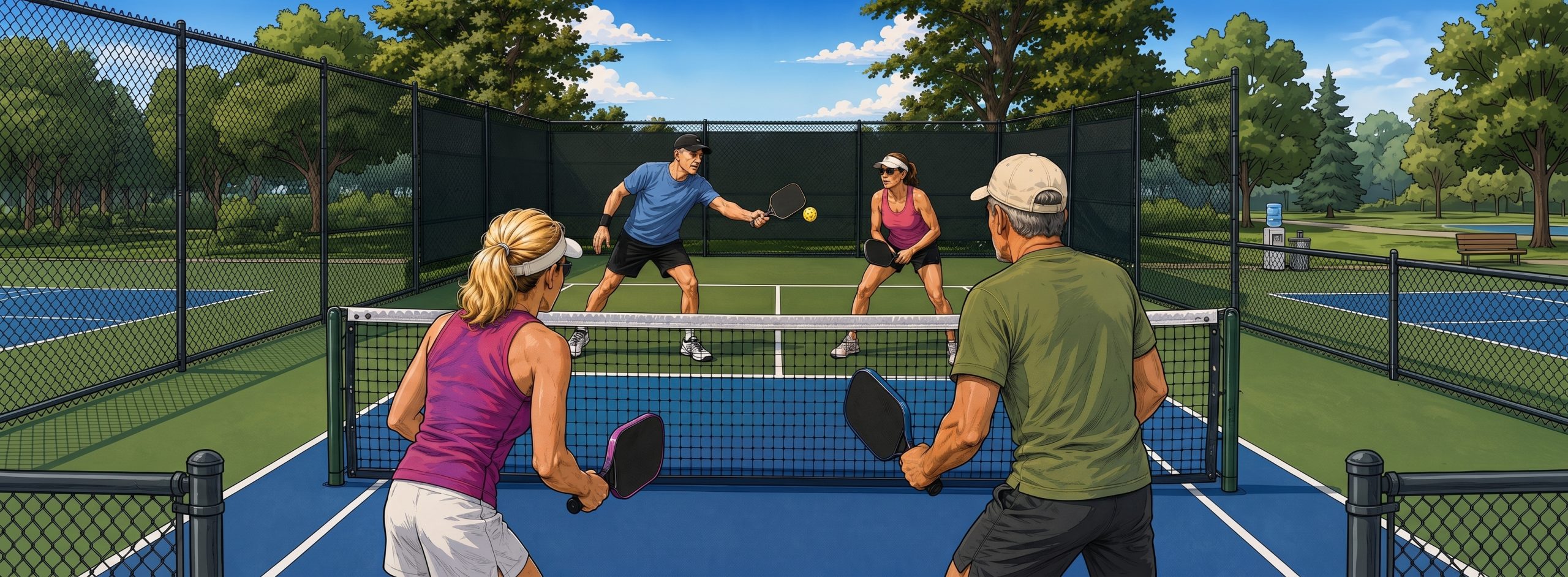
A left-handed opponent can make a perfectly familiar kitchen rally suddenly feel strange.
Balls you normally expect to go to a backhand are going to a forehand. The middle looks open when it is not. A speed-up comes from an angle you were not quite prepared for.
Nothing about the court has changed.
But the strong-side geometry has.
The biggest adjustment against a left-handed player is not changing your entire strategy. It is recognizing where their forehand is and stopping yourself from playing on autopilot.
First: Identify Where the Forehand Actually Is
This sounds obvious, but it is where many problems start.
Against a right-handed opponent, you have probably played thousands of points and developed automatic expectations about which side is forehand and which is backhand.
Put a left-hander across from you and those expectations can be wrong.
Before the game starts, identify:
- Which player is left-handed
- Where that player’s forehand is
- Where the two opponents’ forehands and backhands meet in the middle
Do this before you start trying to exploit anything.
Simply seeing the court correctly is the first adjustment.
Second: Rethink the Middle
The middle is usually a useful target in doubles, but a left-handed player can change what “middle” means.
If a right-handed player is on the left side and a left-handed player is on the right side, both players may have forehands in the middle.
That can make a ball you normally consider safe much more attackable.
The opposite formation can create two backhands toward the middle, which may be a better place to apply pressure.
So do not automatically think:
Middle = safe.
Instead ask:
Whose paddles are actually in the middle?
That tells you much more.
Third: Change Your Dink Targets Accordingly
If you habitually dink to an opponent’s backhand, you need to consciously locate that backhand against a left-hander.
Otherwise, you may spend several points repeatedly feeding their forehand without realizing it.
You do not need to avoid the forehand completely. But when you are trying to create pressure, make an opponent move, or wait for an attackable ball, targeting the backhand can still be useful.
The important part is being intentional.
Do not dink to a spot because it is normally a backhand.
Dink there because this opponent’s backhand is actually there.
Fourth: Expect Different Speed-Up Angles
A left-handed forehand speed-up can arrive from an angle you do not see as often.
That matters particularly during crosscourt dink exchanges.
A ball that normally sets up an opponent’s backhand may now sit directly in a left-hander’s forehand strike zone.
If your dink gets a little high, be ready.
Keep your paddle in front, stay balanced, and pay attention to the opponent’s paddle position rather than relying on your usual expectations.
The ball is not necessarily coming faster.
It may simply be coming from a direction your brain has not learned to anticipate as well.
Fifth: Pay Attention to Forehands-in-the-Middle Teams
A lefty-righty combination can be especially strong when both forehands are toward the middle.
Those teams can attack middle balls aggressively because either player may be comfortable taking them.
Trying to split them with every ball can play into their strength.
Instead, move them first.
Use dinks toward the outside feet and sidelines to stretch the formation. Once one player has been pulled away from the center, the middle can become available again.
You are trying to create the seam before attacking it, rather than assuming one already exists.
Sixth: Use Their Outside Backhands When the Formation Gives Them to You
The same lefty-righty combination that puts two forehands in the middle can leave backhands toward both sidelines.
That gives you another option.
A well-placed dink toward an outside backhand can make the opponent reach, move laterally, or produce a more defensive reply.
You do not need to hit extreme angles.
A controlled ball toward the outside foot may be enough to move the player and change the next shot.
Think placement before pace.
Seventh: Do Not Overcorrect
Once players notice someone is left-handed, they sometimes become obsessed with it.
Every ball suddenly has to go to the backhand.
That makes you predictable.
A good left-handed player still has a backhand. A good right-handed player does too. Neither one automatically has a weakness just because of which hand holds the paddle.
Use handedness to understand the geometry, not to make assumptions about ability.
If the left-hander is crushing backhands but struggling with low forehands, believe what the match is showing you.
Drills to Get Comfortable Against Left-Handed Players
Forehand/Backhand Recognition Drill
During a practice game, identify each opponent’s forehand and backhand before every serve. This sounds simple, but it retrains the automatic assumptions that cause mistakes against left-handed players.
Lefty-Righty Middle Drill
If you have access to a left-handed player, set up a lefty-righty pair with both forehands toward the middle. Dink against the pair and experiment with outside targets before returning to the middle. Notice how moving one player changes the seam.
Speed-Up Recognition Drill
Dink crosscourt with a left-handed partner and allow random speed-ups. Focus on reading paddle preparation and ball height rather than anticipating the shot based on the patterns you are accustomed to against right-handed players.
A Quick Self-Check During Matches
If a left-handed opponent is giving you trouble at the kitchen line, ask:
- Where is their forehand?
- Are there two forehands or two backhands in the middle?
- Am I feeding their strength out of habit?
- Am I watching the paddle or assuming where the next attack will come from?
Usually, the adjustment is smaller than it feels.
The Real Key
Playing a left-handed opponent does not require a special left-handed strategy.
It requires you to stop seeing the court by habit.
Identify the forehands.
Identify the backhands.
Look at what the middle actually contains.
Then choose your targets accordingly.
Once you start seeing the real geometry instead of the one you are accustomed to, left-handed players become much less confusing.